The Ultimate Guide to Journaling with Prompts
By Manav Garg · July 26, 2026
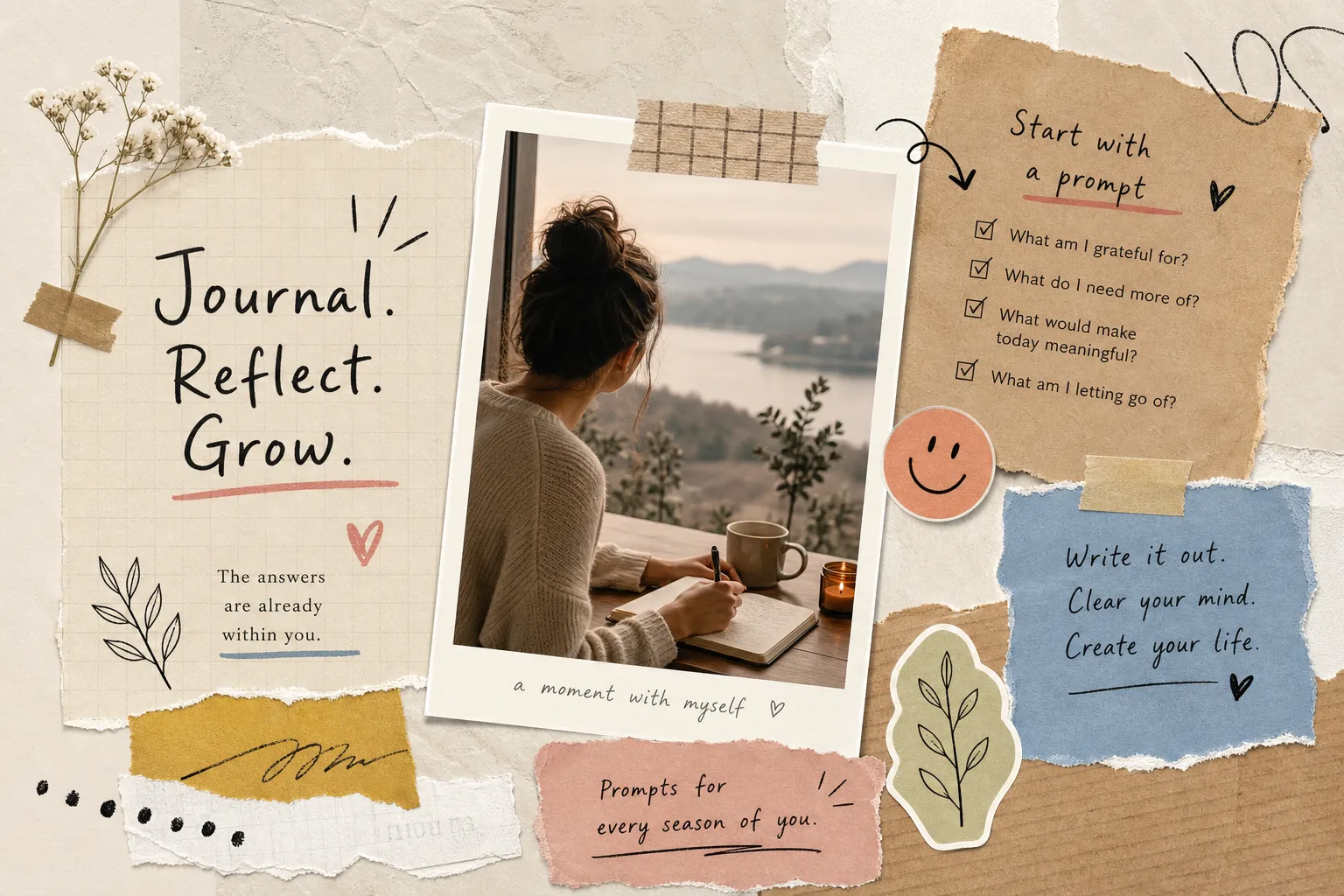
You sit down, open a fresh notebook, and then nothing happens. The blank page isn't the problem, it never was. The missing piece is a starting point, a single well-placed question that cracks the door open just enough for your thoughts to walk through. A journal with prompts solves exactly that. Instead of staring at white space, you get a focused question that points your mind in one direction and lets it run from there.
That same mechanic works far beyond paper. At PromptsEdge, we've built an entire platform around the idea that the right prompt is a catalyst. Whether someone is generating cinematic AI images or working through a morning reflection, the principle is identical: a structured starting point unlocks creative output that open-ended freedom rarely produces on its own. The best prompted journals and the best prompt engineering communities run on the same logic.
This guide covers every format of journal with prompts available in 2026, gives you sample prompts to try before you buy anything, walks through the specs that separate a good journal from a frustrating one, and lists the top picks by use case with current pricing.
Why a structured prompt beats a blank journal page every time
Blank pages trigger decision fatigue. The moment you open an unstructured notebook, your brain faces an infinite question: what should I even write about? That question alone is enough to shut the whole session down. A focused prompt eliminates it by giving your mind a bounded problem instead of a limitless one.
Research in creativity and cognitive psychology consistently supports this. Studies on constraints and creative output find a significant positive relationship between the two, a finding replicated across writing, design, and problem-solving contexts. The effect works because constraints shift your mental energy from "what do I write?" to "what do I actually think about this specific thing?" That shift is the entire difference between a productive session and a wasted one.
The psychology behind why constraints spark better ideas
Creative freedom sounds appealing, but too much of it activates the same paralysis as standing in front of a menu with 200 options. Constraints do the opposite: they narrow the search space just enough for your mind to start moving. The best prompts don't answer your questions for you; they just give you a specific door to walk through.
This is why professional writers use writing prompts, why therapists use structured reflection questions, and why content creators who journal consistently tend to outperform those who journal sporadically. The prompt removes the activation energy required to begin.
How a daily prompt journal builds creative momentum over time
Writers who follow a structured journal routine develop faster idea generation, sharper observation skills, and stronger narrative instinct over time. The practice isn't about any single entry; it's about building a reflex.
The 365 journal prompts format is one of the most effective versions of this idea. A full year of pre-written prompts functions as a year-long creative training program. You don't have to think about what to write on any given day. You just show up, answer the question, and build the habit one entry at a time.
The four formats of a journal with prompts (and which one fits your goals)
Not all prompted journals work the same way, and choosing the wrong format is the most common reason people abandon a journaling practice. The format has to match the goal. There are four main categories worth knowing before you buy anything.
Gratitude journal with prompts: building positivity as a daily habit
A gratitude journal with prompts is the most accessible entry point for new journalers. The prompts are intentionally simple, things like "three things you're grateful for today" or "one person who made today better." That simplicity is by design. The repetition is the whole point: daily practice rewires attention toward positive patterns over time.
This format works well for anyone who wants a consistent mindfulness habit but doesn't want to spend more than five minutes a day on it. It's low-resistance, low-commitment, and delivers compounding emotional benefits that show up in creative output and resilience over weeks, not days.
Creative and reflective formats: for writers, artists, and storytellers
Creative prompted journals use open-ended questions designed to invite memory, imagination, and playful exploration rather than fixed answers. Prompts in this category might ask you to describe a childhood memory in vivid detail, imagine your life in five years, or write from the perspective of someone you admire. These journals serve writers chasing breakthroughs, visual artists documenting inspiration, and content creators developing a stronger creative voice.
Reflective or therapeutic formats live close to the creative category but turn inward rather than outward. They focus on self-understanding, emotional patterns, and personal growth. Both formats reward consistency, but the therapeutic style tends to go deeper on identity and behavior while the creative style prioritizes idea generation and narrative thinking.
Productivity-focused prompted notebooks: for goal-trackers and planners
The productivity prompted journal is built for people who want their notebook to double as a planning tool. These formats typically include structured sections for daily priorities, decision reviews, and goal alignment, often with pre-printed prompts for morning intention-setting and evening reflection. Entrepreneurs, students, and creators who run content calendars tend to get the most from this format because it connects reflection directly to action.
When shopping for a productivity-style prompted notebook, look for formats that include both morning and evening prompts rather than just one. A journal with prompts on both ends of the day creates a feedback loop: you set an intention in the morning and review it at night, which accelerates progress tracking in a way that single-session formats can't match.
Journal prompts list: 30 starters to try right now
Before you spend a dollar on any journal, try a few prompts to see which format feels right. Each category below gives you representative examples you can use today.
Morning prompts that set creative intention for the day
The Five Minute Journal style is the best-known morning format, and the prompts are deceptively effective. Try these: "What are three things that would make today great?" and "What is your daily affirmation?" Morning prompts work because they front-load direction before the day's noise takes over. They're not about deep reflection; they're about pointing your mind in the right direction from the start.
More morning starters to try:
-
What is one thing I'm looking forward to today?
-
What would make today feel like a win?
-
What is one belief I want to carry into today?
-
Who could I make feel appreciated today?
-
What would I do today if I weren't afraid?
-
What is one small step toward a bigger goal I can take today?
-
What does my ideal version of today look like?
-
What am I grateful for that I often take for granted?
-
What energy do I want to bring into my work this morning?
-
What is one distraction I can remove today?
Reflective evening prompts for writers and creative professionals
Self-discovery prompts do their best work at the end of the day, when the noise has settled and your mind can look backward. Try: "Describe what home feels like," "If you could relive one year of your life, which would it be and why?" and "What would you be doing if money or other people's opinions didn't hold you back?" These prompts surface material that fuels essays, personal projects, and content ideas that free-form writing rarely uncovers.
More evening starters to try:
-
What was the best moment of today and why?
-
What did I learn about myself today?
-
What is something I wish I'd handled differently?
-
Who had the biggest positive impact on my day?
-
What am I letting go of before I sleep tonight?
-
What story did I tell myself today that might not be true?
-
What creative idea surfaced today that I don't want to forget?
-
What made me laugh or smile today?
-
What is one thing I did today that I'm proud of?
-
What do I want tomorrow to feel like?
Creative challenge prompts for artists and content creators
Low-pressure creative prompts work best when they feel more like a game than an assignment. Try: "Find two unrelated objects nearby and brainstorm one clever way they could work together" or "Describe the year so far using only three words." These entry points work especially well for visual artists, YouTubers, and designers who need a daily idea generator rather than a structured reflection tool.
More creative challenge starters:
-
Rewrite a frustrating experience as a comedy sketch premise.
-
Describe your current creative project as a movie trailer voiceover.
-
List five things that do not belong together, then find a theme that connects them.
-
Write a one-paragraph origin story for an ordinary object on your desk.
-
Name one creative constraint you could apply to your next project to make it more interesting.
-
What would your creative work look like if you removed your biggest self-imposed rule?
-
Describe your current mood using only weather terms.
-
What is a creative risk you've been avoiding? What's actually stopping you?
-
Write the worst possible version of your current idea, then find what's salvageable in it.
-
Imagine your creative process as a character. What does it look like, and what does it need from you right now?
The best prompt engineers on PromptsEdge use this same muscle: constrained, playful iteration that generates something unexpected every time. When you journal with prompts regularly, you're training exactly the same creative reflex.
What to look for before you buy a journal with prompts
Most buyers choose a journal based on cover design and regret it the first week. The specs that actually determine whether you'll use it daily are the ones nobody talks about on the product page.
Dated vs. undated, page count, and paper weight
Dated formats create accountability because you can see exactly where you skipped days. Undated formats are better for irregular journalers who want flexibility without guilt. Page count matters practically: at one page per day, a 365-page journal lasts a year, while a 120-page journal lasts four months.
Paper weight is the spec most buyers overlook. Here's a quick breakdown:
-
Under 60 GSM: Expect bleed-through from most ballpoint pens.
-
70, 80 GSM: Handles most pen types cleanly; a solid everyday choice.
-
100, 120 GSM: Premium range, designed for heavy daily use with markers or fountain pens.
-
Lay-flat binding: Essential for comfortable daily writing; journals that won't lie flat on a desk get used far less often.
Size, price range, and whether refillable options are worth it
A5 (roughly 5.5 by 8.3 inches) is the most commonly recommended size for daily journaling because it offers enough writing space without being too large to carry. Budget journals run $6 to $12, mid-range options sit between $15 and $25, and premium guided journals like The Five Minute Journal at $25 to $30 justify the cost through higher paper quality and intentional design. Refillable prompted notebooks are worth considering for committed daily journalers: the upfront cost is higher, but the long-term cost per page drops significantly after the first refill.
The best journals with prompts to buy in 2026
The right pick depends on your goal, not on Amazon rankings. Here are the top recommendations organized by use case.
Best for memory and family storytelling
"Dad, I Want to Hear Your Story" (around $6.08) and "Mom, I Want to Hear Your Story" (around $7.14) are among the top best-sellers in Amazon's Guided Journals category in 2026, with thousands of verified reviews between them. Both are prompted notebooks built around family memory capture, making them ideal gifts and collaborative keepsakes. They work well even for people who don't consider themselves writers because the prompts do all the heavy lifting.
Best for daily creative habit and self-reflection
The Five Minute Journal ($25 to $30) is a widely recognized choice for morning and evening structured prompts. Its consistent format builds the habit faster than most journals because it removes all decisions from the process. The Better Every Day Journal offers 365 pre-dated prompts with a self-love and wellness focus, making it a strong alternative for writers and creators who want more variety without losing structure.
Best for gratitude, wellness, and mental health journaling
Gratitude Journal: Daily Mindfulness Prompts (~$10.11), 5 MINUTES A DAY Self-Care Journal (~$12.16), and Mental Health Journal for Women and Men (~$9.99) round out the wellness category. Studies on gratitude practices suggest that structured daily reflection produces meaningful improvements in emotional resilience over time, and the accessible price point on these options makes them easy to try without significant commitment.
Where to buy your next guided journal and what to expect
Amazon carries the widest selection with the most competitive pricing and straightforward returns within 30 days on most orders. It's the easiest starting point for any of the journals listed above. Etsy is the place to look for handmade, small-batch prompted notebooks and fully custom journals when standard formats don't fit your specific needs.
Brand sites like Intelligent Change (The Five Minute Journal) often offer bundles and the most complete product information. Barnes & Noble and Staples carry branded options from Moleskine, Leuchtturm 1917, and Clever Fox in-store for anyone who wants to check paper quality before committing. Before completing any purchase, verify whether the format is dated or undated, check the review count (not just the star rating), and confirm the return policy on premium options, Etsy policies vary by seller.
A journal with prompts is creative infrastructure
A prompted journal isn't a self-help product. It's a creative infrastructure tool that gives your practice a reliable engine, whether you're using it for gratitude, self-discovery, storytelling, or daily idea generation. The specific journal matters less than committing to the prompted format consistently and showing up every day.
For memory and family storytelling, start with the Jeffrey Mason series. For daily habits and creative work, The Five Minute Journal or Better Every Day Journal are the most proven options. For wellness and mental health, the gratitude and self-care formats deliver results at a price point that removes all risk.
The best creative practitioners, writers, artists, and prompt engineers alike, share one habit. They don't wait for inspiration. They build the conditions for it, one well-chosen prompt at a time. If you want a deeper library of prompts to fuel that practice, PromptsEdge is where creators come to find and share the prompts that actually work.